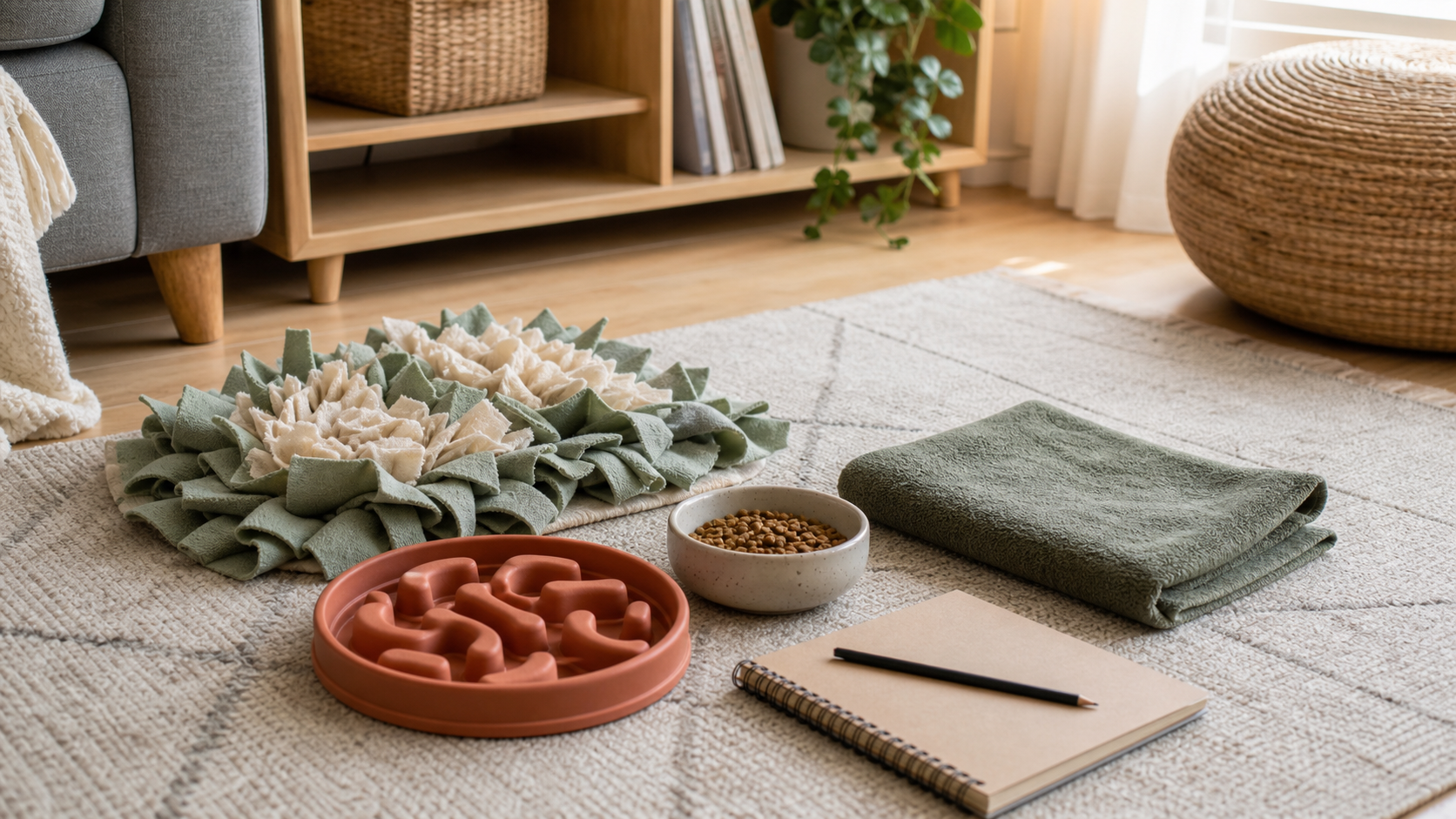
Dog enrichment advice often jumps straight to the puzzle: harder, cleverer, more steps, more hidden food. Apartment owners need a different first question. What happens when that toy hits a wood floor at 7 a.m., slides under a sofa, traps wet food in a seam, or becomes something the dog wants to chew apart?
Start with the room, then pick the activity
The ASPCA's enrichment guidance includes food puzzles, scent games, and simple activities that make routine moments more engaging. That is a useful starting point, but it does not mean a product with the most compartments is the best match for a small home.
In apartments, the room changes the recommendation. A hard plastic feeder may be fine on carpet and loud on laminate. A snuffle mat may be quiet but harder to clean after soft food. A toy with loose pieces may be interesting but require more supervision than the owner can provide during a work call.
The product photo will not tell you the sound
Sound is one of the hardest things to judge from a listing. Hard plastic, hollow chambers, loose lids, and excited pawing can make a toy much louder than it looks. A rubber base, heavier body, or use on a rug can matter more than the difficulty rating.
Cleaning deserves the same attention. Narrow slots and wet food can turn enrichment into dishwashing. If the owner has to dig food out of corners every night, the toy stops being a routine and becomes an extra chore.
A quiet item is not automatically a safe item
The ASPCA's position statement on chews and treats emphasizes matching items to a dog's size and chewing habits and watching how the dog handles them. That point applies beyond chews. Soft does not always mean safe, and quiet does not always mean low-maintenance.
A dog that chews hard may need a different material than a dog that nudges food gently. A dog that removes pieces quickly may need closer observation or a simpler activity. A small apartment guide should say this plainly instead of treating enrichment as a product that can run unattended in the background.
The apartment test before buying
Where owner feedback is useful
For a future product-specific guide, public feedback is most useful when many owners describe the same physical issue in their own homes: sliding across floors, loud rattling, stuck food, weak suction cups, pieces that pop out too easily, or dogs solving the puzzle by flipping it over.
Those patterns can be summarized in original wording. They should not be copied as review text, and they should not be used to imply PetRoutineGuide watched a dog use the toy unless that testing actually happened.
What not to promise
Do not describe a puzzle toy as treating separation anxiety, aggression, panic, destructive behavior, or any medical issue. If a dog is distressed, unsafe, or showing a serious behavior pattern, the article should steer readers toward qualified professional help rather than letting a product carry the whole answer.
Review basis
This is a research-based small-space enrichment guide, not a direct product-testing review. PetRoutineGuide did not test a specific toy for this article and does not use affiliate links here.
Sources
ASPCA, Canine DIY Enrichment; ASPCA, Position Statement on Dog Chews/Treats; American Humane, Interactive Food Toys. These sources support general enrichment and toy-safety framing, not product endorsements.